
Cube of the New World: Real-Time Voxel Experience at Onesight Global
Explore Cube of the New World, an interactive voxel experience demonstrating real-time 3D WebGL development. See how Onesight Global executes creative engineering.
In this article
- Cube of the New World: a voxel voyage across the Atlantic
- A focused demo, not a feature-rich product
- What This Demo Shows About Real-Time 3D Craft
- From a lean concept to a polished, end-to-end deliverable
- Game Development & XR and Digital Product Development for your build-vs-partner call
- Try it live, then scope your own project
- References
When you are deciding whether to build creative 3D, game, or XR capability in-house or partner out, most teams make the call from decks and render reels. Those artifacts show what work can look like at its best; they rarely reveal how it performs under real conditions, who is accountable when it breaks, or whether a small team can actually carry a concept through to something that holds together. That gap matters, because interactive experiences live or die on responsiveness and craft you cannot see in a static slide.
Cube of the New World is Onesight Global's attempt to close it. It is a live, browser-based voxel experience hosted at cotnw.onesight.global [1] — Onesight's own subdomain, so it is made by the firm rather than borrowed from a third-party demo host. The page carries almost nothing: a title, the tagline "Charting the seas…" [1], and one interaction, rolling a voxel world cube across an ocean from the Old World to the New. No feature list, no pricing tiers, no signup wall between opening the URL and driving the cube. It is deliberately a focused piece rather than a full product — which is precisely why it works as evidence of craft instead of a marketing artifact.
This article uses Cube of the New World as proof rather than decoration. You will see what the live render actually demonstrates about real-time 3D web experience and interactive design; how a lean concept becomes something that feels finished; and how that discipline connects to Onesight's Game Development & XR and Digital Product Development offerings. The goal is to give you a concrete basis for your build-vs-partner call — so you can evaluate the actual thing before committing to either path.
Cube of the New World: a voxel voyage across the Atlantic
When you visit cotnw.onesight.global [1], the first thing you get isn't a landing page full of claims — it's a single interactive scene. The experience is titled Cube of the New World [1], and it runs on a subdomain of Onesight Global's own domain. That placement tells you whose work this is immediately: not an embedded third-party widget or a hosted demo on someone else's turf, but something Onesight controls.
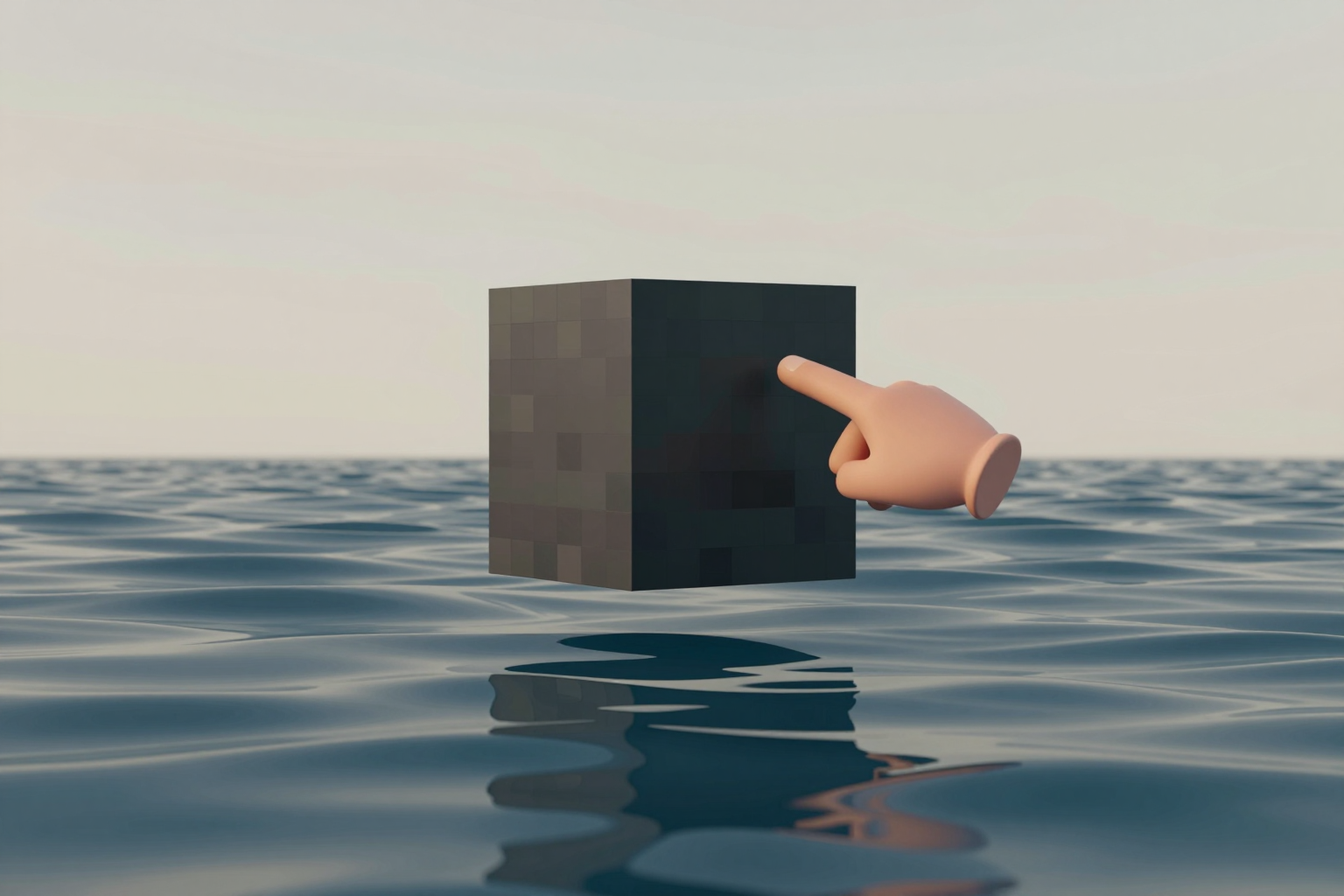
The scene is minimal by design. You see an ocean and a voxel cube standing in for a world; the only text on the page is the title plus a short tagline — "Charting the seas…" [1].
The whole thing collapses to one action. You roll the voxel world cube across the water on a voyage from the Old World to the New [1]. The theme behind it — charting and exploring the seas — sits under that interaction without being spelled out in mechanics or scope notes.
A focused demo, not a feature-rich product
What is actually on the page
Open cotnw.onesight.global and you get exactly one thing — a voxel world cube rolling across an ocean [1]. That single action is the entire experience — no level select, no score or progression screen, no settings menu, no onboarding steps, and no signup wall hiding additional capabilities. There is no narrative depth revealed here, no game systems you can poke at, nothing beyond the cube and its roll.
If you are scanning for a feature list, you will not find one. That omission is deliberate, not an oversight.
No plans, no pricing — deliberately
This page carries no pricing tiers, no subscription plans, and no tiered feature comparison [1]. A product page typically layers those to justify a purchase; this one shows a single thing and leaves your judgment unsteered by anchor pricing. You are not being funneled toward a "Pro" plan or nudged into a trial.
Open it and judge the real thing
There is no download, install, or account step between opening the URL and interacting with the cube. That is intentional: it lets you evaluate the actual artifact rather than a feature deck or slide presentation, which reinforces the article's larger build-vs-partner question — judge what they actually built, not what someone claims they can build.
What that tells you about how they deliver
That restraint about scope is a signal of how Onesight frames deliverables more broadly: what you see is what you get from a single accountable end-to-end partner that combines strategy with delivery. It sets an expectation before Section 3 makes technical craft claims — the surface is lean on purpose, which means the engineering underneath earns its keep rather than hiding behind feature layering.
This is a concrete artifact you can look at and test, not a pitch dressed up as proof — which is exactly how you should treat everything below it. And none of it is an engineering spec you could defend at a board meeting: no engine name, frame rate, voxel or polygon counts, or load time is claimed for this piece. Those details aren't part of what it presents; treat them as general guidance until checked against the live experience rather than reading that silence as either a limitation or a promise.
What This Demo Shows About Real-Time 3D Craft
The artifact answers that directly — you can read the engineering straight off what renders on screen. Minimal surface ≠ limited craft.
A live render, not a recorded clip
Cube of the New World is Onesight Global's own live demonstration at cotnw.onesight.global [1], and what it shows is a real-time 3D render — a world that reacts to input in the browser rather than playing back a pre-rendered clip or holding a static frame. A recorded video replays identically on every loop; this one responds differently to each input you send when you roll the cube. That reaction is live, not baked into playback.
Coherent geometry under motion
The voxel graphics read as coherent geometry — blocks form a unified surface that rolls and holds together under motion instead of breaking into loose pixels. This is an observation of the visible rendering, not a measured technical claim, so treat it as general guidance until you watch it in person rather than trusting a spec sheet.
In-browser, where your users already are
The demo runs in the browser using standard web technologies rather than requiring a separate application or plugin download [1]. The deliverable lands where your users and reviewers already are — no install step between opening the URL and interacting with the cube. That is an observation of how the artifact executes, framed as general guidance: specific engine or framework choices (such as whether it renders via WebGL) are not documented publicly, so treat it accordingly rather than a capability guarantee for every project.
The live-condition test
The real test of craft here is smooth interactivity under live conditions: performance and responsiveness while you actively drive it. Watching recorded playback hides friction; driving it live exposes it, which separates a polished deliverable from a prototype.
From a lean concept to a polished, end-to-end deliverable
The craft is in the details
A cube rolling across an ocean could be left as a mechanical translate-and-halt — functional, but rough. What turns that into something that feels finished lives entirely in the margins: the acceleration and deceleration of the roll, the way it settles instead of snapping to rest, and how consistently every tap produces the same predictable response with no jitter or lag. Readability matters as well — while the voxel surface turns, you should still tell where you are and which way is forward. That single design decision separates an oriented, coherent world from visual noise. These are general standards for what distinguishes polished work from unfinished work; they describe how craft is judged rather than measured results taken from this specific demo.

Continuity over novelty
Rolling the cube once is easy. Carrying one premise through first render, every interaction, and a coherent finish into something that simply holds together is where discipline shows — and it is repeatable capability, not one-off luck. That pattern mirrors Onesight's Digital Product Development, where full-stack teams take products from zero to production with continuity and scaling already built in. Cube of the New World at cotnw.onesight.global is Onesight's own artifact, so the judgment behind it reflects how the firm builds deliverables: carrying a lean concept through to something that holds together end-to-end rather than leaving it as a rough sketch [1].
The same rigor, applied wider
The discipline here scales. Engineering built for continuity and scaling is what separates a throwaway novelty from a load-bearing system where downtime or drift is not acceptable — the same continuity-and-scaling standard that underpins Onesight's Digital Product Development work.
Game Development & XR and Digital Product Development for your build-vs-partner call
The cube as a window onto two capabilities
The rolling voxel cube is not merely a rendering exercise; it opens onto two of Onesight's live offerings at once. It demonstrates immersive, game/XR craft — building interactive worlds — and end-to-end product delivery, where a concept is carried through to something that ships and scales.
Game Development & XR
This demo sits at one end of a broader capability band. Onesight's Game Development & XR covers Unity and Godot game development plus augmented-reality and interactive real-world scenarios that merge digital and physical, for clients building immersive experiences. The voxel cube is browser-based interactive work; the same team can move up that ladder to native games or AR deployments where the boundary between screen and environment dissolves.
Digital Product Development
The other capability behind the cube is end-to-end delivery. Onesight's Digital Product Development covers product strategy, enterprise-grade platforms, and full-stack teams taking products from zero to production with continuity and scaling built in. The discipline that keeps this demo coherent — motion, weight, consistent interactive response — is the same one applied when a customer-facing or internal platform must survive real traffic rather than look good on day one.
The build-vs-partner call
Onesight positions itself as a single accountable end-to-end partner combining strategy with delivery. That framing exists for exactly your situation: CTOs, VPs of Engineering, and technology decision-makers weighing whether to build or partner while deciding what capability actually looks like before committing.
Consider the concrete trade-off. Hiring a small in-house WebGL/3D team carries ramp-up time, retention risk, and ongoing overhead before the first asset ships; engaging Onesight on a fixed-scope immersive project converts that into a known scope and a shipped artifact. Both paths are defensible. The question is whether you can verify capability before you commit.
This is the same build-vs-partner tension enterprises face when they need to ship faster without degrading reliability — whether accelerating development through AI How Enterprises Are Using AI to Cut Product-Development Time-to-Market. In every case, the move from a deck to a live artifact changes how you evaluate the partner.
Use the live demo as your verification tool rather than leaning on resumes or case-study slides — "this is what our team ships" carries more weight in an evaluation conversation than a polished deck. Onesight has operated since 2014 across four continents as an end-to-end tech advisory and digital product development firm, so this artifact reflects sustained practice rather than a one-off showcase. See the full offering at https://onesight.global/services, then try it live at cotnw.onesight.global before you decide whether this team can ship your project.
Try it live, then scope your own project
Drive it before you decide
Cube of the New World sits at cotnw.onesight.global [1], on Onesight Global's own subdomain, and there is nothing between opening that URL and rolling the cube: no download, no install, no signup wall, no form to fill before you can judge it. Use that access as your own pre-call homework rather than a reason to schedule one first — try the experience before deciding whether Onesight is worth a conversation.
Open it on a work laptop and an older machine or phone, then watch how the voxel surface responds across both. If motion stays smooth under ordinary conditions instead of only inside a polished render reel, you have run the same live-condition test that separates a finished deliverable from a prototype [1]. That criterion was already established in Section 3; here it becomes something you apply on your own hardware.
Bring your own evidence into the room
When you do talk to Onesight about whether creative-3D work fits your roadmap, lead with what you actually saw rather than their slides. A screenshot or short clip of the cube driving on your own machine — "this is what our potential partner ships" — is a more honest capability statement than a case-study deck, because it cannot be selectively rendered for a pitch [1]. This is general guidance on how you might evaluate the demo, not a measured guarantee about every project.
Scope it as a project
If immersive work matters to your roadmap, Onesight's Game Development & XR covers Unity and Godot development plus augmented-reality scenarios that merge digital and physical, alongside browser-based craft like this demo. If any of that is relevant, reach out to discuss scoping it — framed as a next step you can take, not a promise of outcome or timeline.
Talk to Onesight about a similar creative 3D/game/XR project → https://onesight.global/contact
References
- Cube of the New World — cotnw.onesight.global.